
Nobody likes waiting in line. In Hong Kong, where expectations are high and alternatives are always one MTR stop away, a chaotic queue can cost you a customer permanently. The good news is that a well-set-up queuing system doesn't just tidy up your entrance. It actively improves the experience for customers, takes pressure off your staff, and gives management visibility into exactly what's happening on the floor. Sea Point has been deploying queue management systems across Hong Kong's retail, F&B, and hospitality sectors for years. What we keep seeing is the same: the businesses that get queuing right create noticeably better environments for everyone in them. In 2026, that's table stakes, not a bonus.
Why Do Hong Kong Businesses Struggle With Queue Management?
Hong Kong moves quickly. Customers here expect efficient service, and as soon as they feel a wait is unmanaged—without a clear process or a sense of how long it will take—their patience wears thin. This isn't a complaint; it's simply the reality of the market. For businesses in high-footfall locations, losing a customer due to a chaotic queue is a more common occurrence than many managers care to admit.
The real issue with manual queue management isn't that it fails daily; it's that it fails precisely when you need it most, such as on a Saturday afternoon during a public holiday rush when you're likely already short-staffed. In these moments, staff may find themselves overwhelmed, the wait time estimates become unreliable, and the customer experience suffers just when you have the most customers to impress.
A queuing management system doesn't solve the problem of poor service, but it does create an environment where good service can happen consistently. Staff won’t be overwhelmed trying to manage the line, management will have access to real data for decision-making, and customers will know what to expect.
Ticketing System, Queuing System, Smart Queuing System: What's Actually Different?
Vendors throw these terms around loosely, so it's worth being precise.
A ticketing system is the original version: a machine spits out a number, you wait, your number gets called. Simple, cheap, and perfectly functional for lower-volume settings.
A queuing system is the broader category. It covers any structured approach to managing customer wait times, from that basic ticket machine all the way up to fully connected digital platforms.
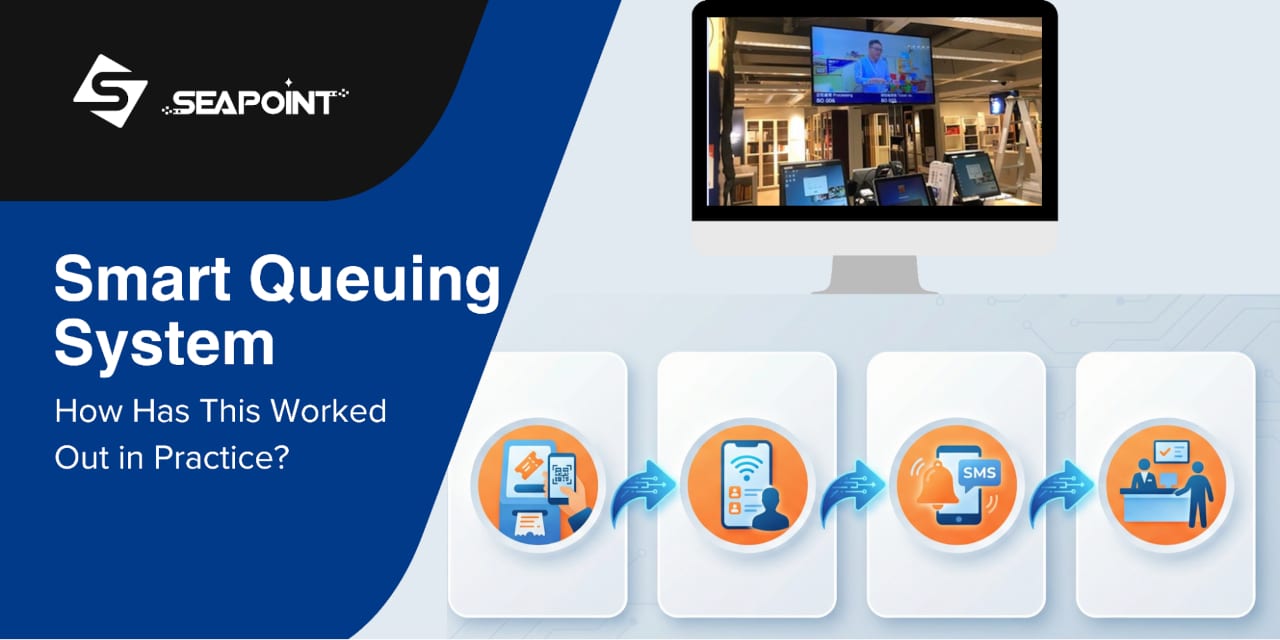
A smart queuing system is a different beast entirely. Customers scan a QR code to join a virtual queue, get an SMS when they're nearly up, and are free to keep browsing or sit down while they wait. The system captures data on every interaction and plugs into your existing tools: POS, CRM, digital signage. For businesses running multiple locations or planning to grow, going straight to a smart system almost always makes more financial sense than starting basic and replacing it later.
What Should an effective Smart Queuing System Actually Do?
Sea Point's EnQue system was built around real operational environments rather than theoretical feature sets. It's modular, so it can be configured for a single-counter restaurant, a flagship retail store, or a multi-floor service centre, and it scales as the business does.
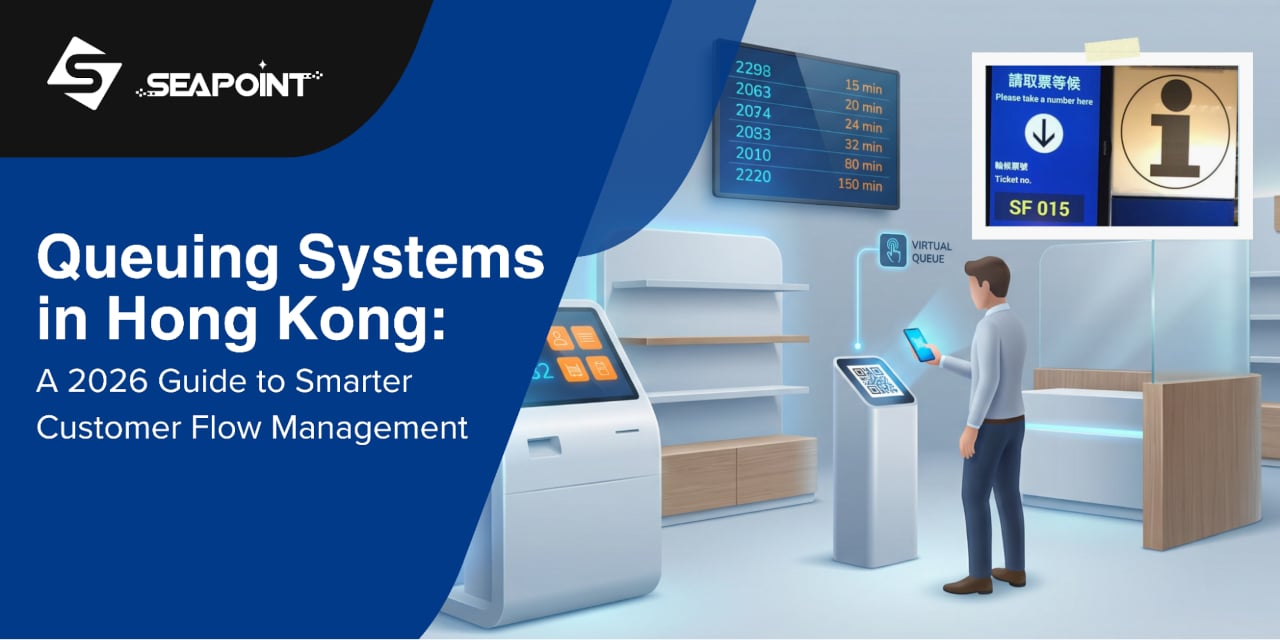
Customers have two ways in: a self-service kiosk at the venue, or a QR code scan from their own phone. With virtual queuing active, they join the queue digitally and get an automatic SMS alert when they're next. No waiting by the counter. No hovering. The system comes to them. For retailers especially, this has a direct commercial impact. A customer who keeps browsing while they wait is a customer who might actually pick something up before they reach the cashier.
On the display side, EnQue connects with their digital signage to show live queue numbers and wait times. On the same screens, promotional content and campaign messaging can run at the same time, so the signage is doing real work, not just displaying a number.
The backend dashboard gives managers a live picture of customer volume, service speed, and staff throughput across every location. That's the kind of data that makes staffing decisions less of a guessing game. EnQue also connects cleanly with POS systems, CRM tools, and other enterprise platforms, so it slots into your existing setup rather than adding another disconnected layer.
According to observations from Sea Point, retail stores equipped with virtual queuing features see a significant increase in the time customers spend in-store while waiting, which helps to enhance the overall shopping conversion rate.
Real-World Applications of Sea Point's Queue Management System in Hong Kong
Here are two real examples of EnQue deployments in Hong Kong: what the situation was, what was installed, and what changed.
International Home Furnishings Retailer: A Six-Year Partnership That Kept Evolving
One of the world's best-known home furnishings chains has been running Sea Point's EnQue system across its Hong Kong locations for over six years. When they first came to us, the problem was straightforward: service counters were getting overwhelmed, the waiting area was crowded, and it was making the whole store feel more stressful than it should. The initial installation sorted the immediate chaos. But as customer numbers grew, a different limitation emerged. Physical queue tickets meant customers had to stay near the counter, which wasn't great for the store experience or their shopping habits.
Sea Point's team rolled out QR code virtual queuing as an upgrade. Customers now scan in, join the queue on their phone, and get an SMS when they're nearly up. They keep exploring the store in the meantime. Store managers can see the queue position across all locations from the dashboard and shift staff around accordingly. The customer experience improved measurably, and in-store sales reflected it. The full story is in the Home Furnishings Store case study.
Australian-Themed Steakhouse Chain: When Waiting Becomes Part of the Experience
A popular Australian-themed steakhouse chain with several Hong Kong locations had a problem that's common in casual dining: weekends and public holidays brought in far more customers than the waiting area was designed to hold, and the team was spending too much time managing the crowd instead of taking care of the guests already seated. Sea Point installed a smart queuing solution across their branches. Customers now take a number at a kiosk when they arrive and get a notification when their table's almost ready. The bottleneck at the front cleared up, and staff could actually focus on hospitality again.
As part of the same project, Sea Point installed customised LED transparent displays throughout the restaurants. With the queuing and digital signage systems working together, waiting customers could check their queue position on screen while the displays were also running promotions and menu highlights. What used to be dead time just standing around waiting for a table became a moment the brand could actually use. That kind of dual-purpose setup is what makes the investment go further.
What Should You Actually Look for When Choosing a Queuing System?
The market has plenty of options and the specs can start to blur together. Here's what tends to matter most once a system is running in the real world.
Scalability is the one that bites businesses who don't think about it early. A system that works at one location but breaks down when you open a second, or requires a full replacement, isn't a long-term solution. Look for something built for central management across sites, with the ability to add capacity without a major rebuild.
Integration is where a lot of systems quietly underperform. If your queuing platform can't talk to your POS, your signage, or your CRM, you've added a tool without adding much intelligence. The best setups share data across systems: the queue feeds the signage, the POS data informs staffing, and everything reports to the same dashboard.
Local support doesn't always make the shortlist during evaluation, but it's usually the thing people wish they'd prioritised after go-live. A queue management system is a core tool for frontline operations, and any technical failures can directly impact the customer experience. Having a Hong Kong-based team who can respond quickly is a practical requirement, not a nice-to-have. Sea Point's support team has a local presence precisely for this reason.
Industry fit is also worth checking. A supplier who's already deployed in your sector understands the specific pressures. Table turnover timing in restaurants is a different problem to managing service counter flow in a pharmacy. Relevant experience gets you to a working system faster with less trial and error.
Where is the Smart Queuing System heading in 2026?
The short version: queuing is shifting from a crowd control problem to an experience design problem.
Virtual queuing and contactless experiences have become mainstream in the market. The widespread adoption of QR code queuing allows customers to complete the queuing process without touching physical terminals, meeting Hong Kong's dual demand for hygiene and convenience while significantly enhancing the overall customer experience. At the same time, the notification channels of the system are constantly expanding. In addition to traditional SMS, the integration of WhatsApp and email notifications is gradually becoming a standard feature of the new generation of queuing systems, aligning more closely with the daily habits of Hong Kong consumers. On the data application front, the backend analytics capabilities of queue management systems are continuously being strengthened.
Some systems can now predict peak periods based on historical customer flow data, helping management allocate staff in advance and minimizing the risk of service delays. The queue terminals themselves are also evolving into multimedia interactive platforms, allowing businesses to display promotional information or brand content during customer wait times, effectively transforming wait time into valuable business touchpoints.
For more information on Sea Point's queue management system solutions, please refer to our official service page or contact our technical consulting team directly. You can also explore our successful IT technology intelligent case studies to learn more about industry applications.
Frequently Asked Questions
1. Which industries in Hong Kong get the most out of a queuing system?
Retail, restaurants, hotels, banks, healthcare clinics, and government service centres are all strong fits. In Sea Point's experience, retail and F&B clients tend to see the most immediate effect: less crowding, cleaner service flow, and customers who leave happier. That said, any business with consistent foot traffic and a structured service process will benefit from getting the wait right.
2. What's the actual difference between a smart queuing system and a basic ticketing machine?
A ticketing machine gives out numbers. A smart queuing system manages the whole experience. Customers join virtually by QR code, get notified when they're nearly up, and can keep moving while they wait. It also captures data on every interaction and integrates with your existing platforms. A ticketing machine can't do any of that.
3. Can EnQue connect with our existing digital signage or POS setup?
Yes, and it's one of its stronger selling points. EnQue integrates with digital signage, POS systems, and management dashboards without requiring a full technology overhaul. In-venue screens can show live queue status and promotional content simultaneously, and managers get a single unified view across all connected systems.
4. How long does installation take?
Scope and customisation level determine the timeline. Sea Point manages the full process: requirements, design, installation, testing, and post-launch. The team works around operational hours to minimise disruption. Get in touch for an estimate based on your specific setup.
5. Is there local after-sales support available in Hong Kong?
Yes. Sea Point's Hong Kong team handles support for all deployed systems directly, so response times are quick when something comes up. If you'd prefer to see the system in action before committing, the Hong Kong demo centre is open for visits. Just contact us to arrange a time.
Ready to Fix Your Queue?
The way a business handles its queue tells you a lot about how it handles everything else. A good queuing system isn't just about managing a line. It's about giving customers a better experience from the moment they arrive, giving staff a cleaner way to work, and giving management the data to make smarter calls. Get those three things right, and it compounds over time into something customers actually notice and remember.
Sea Point has been deploying queue management systems across Hong Kong and the region for years. EnQue is trusted by clients in retail, F&B, hospitality, and beyond. Every installation comes with local support and a team that cares about making it work properly for your specific operation, not just getting it live.
Get in touch or book a showroom visit. No charge, no pressure. Tell us what you're dealing with and we'll give you an honest take on what options will work most effectively for your business.