
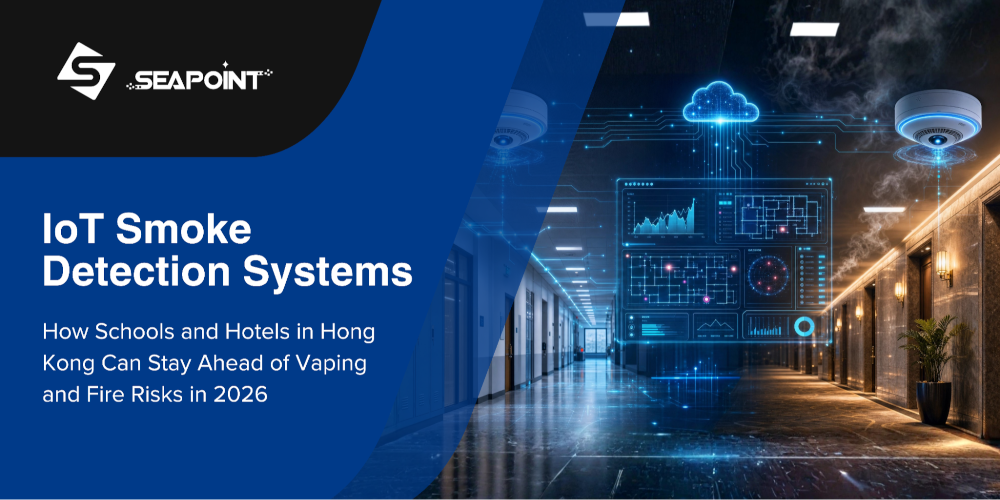
An IoT Smoke Detection System is a networked environmental monitoring solution that connects high-sensitivity smoke and air quality sensors through the Internet of Things, enabling 24/7 real-time detection, automated alerts, and remote management from a centralised platform. Based on Sea Point's hands-on experience deploying smart building solutions across Hong Kong, the key strength of these systems is one platform, dual protection: they don't just detect smoke from fires. They also identify the aerosol from e-cigarettes (through VOC and fine particulate monitoring) while simultaneously tracking indoor air quality (IAQ), giving facility managers a level of environmental visibility that simply wasn't possible before. With Hong Kong's anti-smoking regulations tightening considerably in 2026, demand for proactive smoke monitoring in schools and hotels is rising fast.
Why Is Vaping in Schools Such a Growing Headache for Hong Kong Management Teams?
E-cigarette use among young people in Hong Kong isn't a new issue, but it's getting harder to manage. According to the Council on Smoking and Health Hong Kong, reported drug abuse cases among people under 21 rose from 538 in the first three quarters of 2023 to 593 in the same period of 2024, with e-cigarettes increasingly used as a delivery device for synthetic drugs. The scale of the problem is genuinely alarming.
The core challenge isn't awareness. It's detection. E-cigarettes are designed to be discreet.
- They look like USB drives, stationery, or toys and are difficult to identify on sight
- Unlike cigarettes, they produce little to no lingering odour, and some smell of fruit or candy
- A student can take a few quick puffs in a washroom cubicle and pocket the device in seconds, leaving no trace
- Conventional fire alarm sensors are essentially blind to e-cigarette vapour
That's exactly why manual patrols and visual monitoring can only go so far. Schools need a technical system that can see what the human eye can't.
As Sea Point's technical team notes: "E-cigarette vapour may be nearly invisible to the naked eye, but the PM2.5 fine particles and volatile organic compounds (VOCs) it contains are precisely the signals that IoT sensors are built to detect in real time."
How Does an IoT Smoke and IAQ Detection System Actually Work?
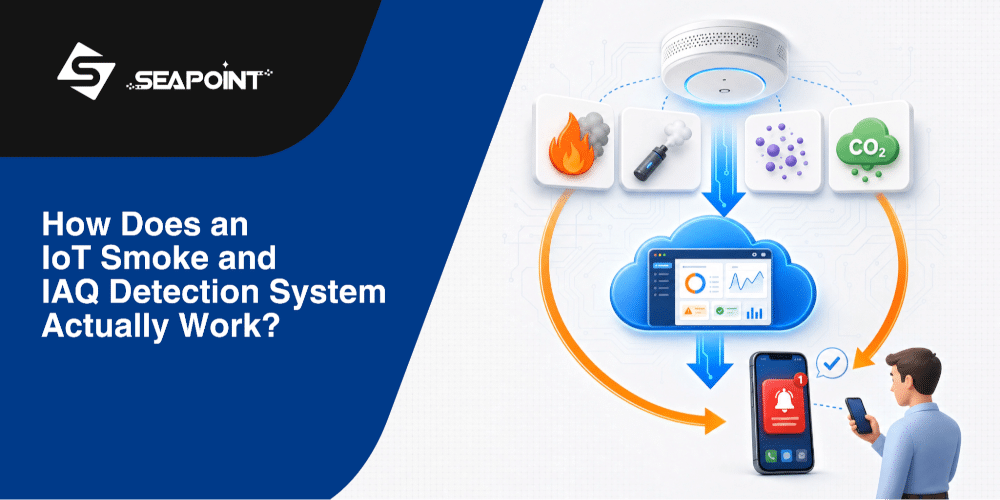
An IoT smoke detection system is defined as a network of intelligent sensors connected via the Internet of Things that continuously monitors an environment for smoke particles, harmful gases, and air quality indicators, transmitting data in real time to a management backend that can trigger automated alerts.
Sea Point's IoT smoke monitoring solution typically integrates the following core sensing modules:
- Smoke Detection: Targets combustion particles for early fire warning
- VOC Detection (Volatile Organic Compounds): Identifies the chemical compounds released when e-cigarette liquid vaporises, even when odour is minimal
- PM2.5 / Fine Particulate Detection: Measures concentrations of ultrafine particles in the air, which spike noticeably when an e-cigarette is used nearby
- IAQ Monitoring (Indoor Air Quality): Tracks CO2, temperature, humidity, formaldehyde, and other key indicators for a complete picture of the indoor environment
When the system detects an abnormal reading, it pushes an alert to the designated manager's phone or dashboard within seconds. Timing matters. That instant response window is what allows staff to intervene before a situation escalates, whether that means addressing a student vaping in a cubicle or getting ahead of an early-stage fire.
School Deployments: Which Locations Matter Most?
Based on Sea Point's project deployment experience, there are a handful of high-risk locations in school environments that should be prioritised from day one.
Washrooms and changing rooms are the obvious starting point. They're the places students are most likely to vape, and they're also the spaces where camera-based surveillance is most restricted. IoT sensors fill that gap directly, and they're just as valuable for fire risk coverage in these areas.
Rear staircases and car parks are another common blind spot. Activity in these areas is hard to monitor visually, and they're frequently used precisely because of that.
Classrooms and corridors benefit most from IAQ monitoring. High CO2 levels or poor ventilation affect students' ability to concentrate and can worsen respiratory discomfort over time. With continuous IAQ data, schools can manage their indoor environment proactively rather than reactively, creating healthier conditions for both students and staff.
It's also worth noting the regulatory context. Hong Kong's Department of Health has confirmed that legislation prohibiting the possession of e-cigarette liquids and pods in public places came into effect on 30 April 2026. Schools now have stronger legal grounds to take formal disciplinary action against violations, and the timestamped data records generated by an IoT system provide objective evidence to support that process.
Hotels: This Is About Brand Reputation, Not Just Fines
For hotels, the consequences of smoking incidents are more complex than many managers expect. When a guest smokes in a non-smoking room, the remediation costs can add up quickly: deep cleaning, replacement of curtains and bedding, air purification equipment, and lost room revenue during recovery. For branded international properties, the reputational impact on top of that is harder still to put a number on.
Priority deployment locations for IoT smoke detection in hotels include:
- Guest rooms: Instant alerts to front desk and security when smoking is detected, enabling rapid response
- Corridors and lift lobbies: Monitoring of public areas to catch guests smoking outside their rooms in non-smoking zones
- Back-of-house kitchens and storage areas: Often underestimated as fire risk zones, where early warning is critical
- Banquet halls and meeting rooms: High occupancy during events makes IAQ monitoring especially important for maintaining comfortable air quality standards
For hotel management, the value of an IoT smoke detection system goes beyond passive alerting. The complete, timestamped data record it generates gives management factual grounds to recover remediation costs from non-compliant guests, directly protecting the hotel's bottom line.
Sea Point's smart building solutions can be configured to match the specific operational needs of any property, with flexible sensor placement and customisable alert rules tailored to hotels of all sizes.
Early Fire Detection: More Important Than You Might Think
Beyond vaping, the fire detection capability of an IoT smoke system deserves attention in its own right. Traditional standalone smoke detectors have some well-known limitations:
- Each unit operates independently, making it slow to pinpoint the exact location of an alarm
- After an alarm triggers, staff have to physically check each area to confirm, costing precious time
- No data is logged, which makes post-incident analysis and continuous improvement nearly impossible
An IoT system brings all sensors into a single management platform. When any sensor anywhere in the building detects something abnormal, the system can, within seconds:
- Pinpoint the alert location precisely (displayed by floor and room number)
- Push an instant notification to the right people
- Automatically log the incident time, duration, and sensor readings as a complete record
According to guidance from the Hong Kong Fire Services Department, early detection and rapid response are the most critical factors in reducing casualties and property loss from fires. A networked IoT smoke system is the technical foundation that makes that rapid response possible.
Why Choose Sea Point for IoT Smoke Detection?
Sea Point is one of Hong Kong's leading smart building technology integrators, with extensive hands-on experience deploying IoT sensor solutions across a wide range of commercial environments. Here's what sets our approach apart:
- End-to-end service: From needs assessment and system design through to installation, commissioning, and after-sales support, our local team handles everything
- Integrated hardware and software: Our sensor hardware and backend management platform are integrated by the same team, so compatibility and system stability are built in from the start
- Scalable by design: Start with a single floor's washrooms and expand to full building coverage as needs grow
- Local technical support: Our Hong Kong office means fast on-site support when it's needed, minimising downtime
- Showroom experience: School administrators and hotel managers are welcome to visit our Hong Kong showroom for a live demonstration of the system in action
No two facilities are the same. Whether you're managing an international school, a local secondary, a boutique hotel, or a large resort property, Sea Point can design an IoT sensing solution that fits your operational reality. Explore Sea Point's full range of Smart Building Solutions or browse our Smart Building Case Studies to see how we've helped clients across Hong Kong.
Frequently Asked Questions
1. Can IoT smoke sensors detect e-cigarettes and vaping?
Yes. Modern IoT smoke sensors incorporate VOC (volatile organic compound) and particulate matter detection modules that can identify the aerosol produced by e-cigarettes, not just smoke from combustion. When the system detects abnormal readings, it pushes an instant alert to the designated manager's phone or dashboard so action can be taken within seconds.
2. How long does it take to install an IoT smoke detection system in a school?
For a typical mid-sized school covering washrooms and common areas, installation is generally completed within a few days without disrupting normal school operations. Sea Point provides a full end-to-end service that covers site survey, system design, installation, commissioning, and staff training.
3. What is the difference between an IoT smoke detection system and a traditional fire alarm?
Traditional fire alarms are designed for large-scale fire events and have high trigger thresholds, which means they often miss the subtle aerosol from e-cigarettes or early-stage smoke build-up. IoT smoke detection systems are far more sensitive, allow configurable alert thresholds, and combine smoke monitoring with IAQ measurement for comprehensive environmental coverage. Alerts are pushed in real time via mobile or dashboard rather than waiting for a full fire alarm to activate.
4. Are IoT smoke detection systems suitable for hotel guest rooms?
Absolutely. Guest rooms, corridors, back-of-house areas, and banquet halls are all priority deployment locations. The system not only detects guests smoking in non-smoking rooms in real time, but also provides early fire detection across the property. This dual protection helps hotels reduce deep-cleaning costs, protect their brand reputation, and build a documented record for recovering charges from non-compliant guests.
5. What integration options does Sea Point's IoT smoke detection system support?
Sea Point's IoT smoke detection system integrates with a centralised management dashboard that supports real-time mobile push notifications, data logging, and report export. It can also be connected with existing smart building management platforms, including access control, CCTV, and other IoT sensors, to create a fully unified building management environment. Visit Sea Point's IT and Innovative Solutions page to explore further integration possibilities.
Ready to Make Your School or Hotel a Safer Place?
Whether you're a school administrator looking to get ahead of student vaping, or a hotel operator focused on guest safety and asset protection, an IoT smoke detection and IAQ monitoring system is one of the most practical smart building investments available in 2026. Sea Point welcomes enquiries from facility managers and industry partners, and our Hong Kong showroom is open for demonstrations by appointment. Get in touch, and let's work out the right solution for your property.
Contact us or book a showroom visit for a free consultation and live demonstration of Sea Point's IoT smoke detection solutions.