
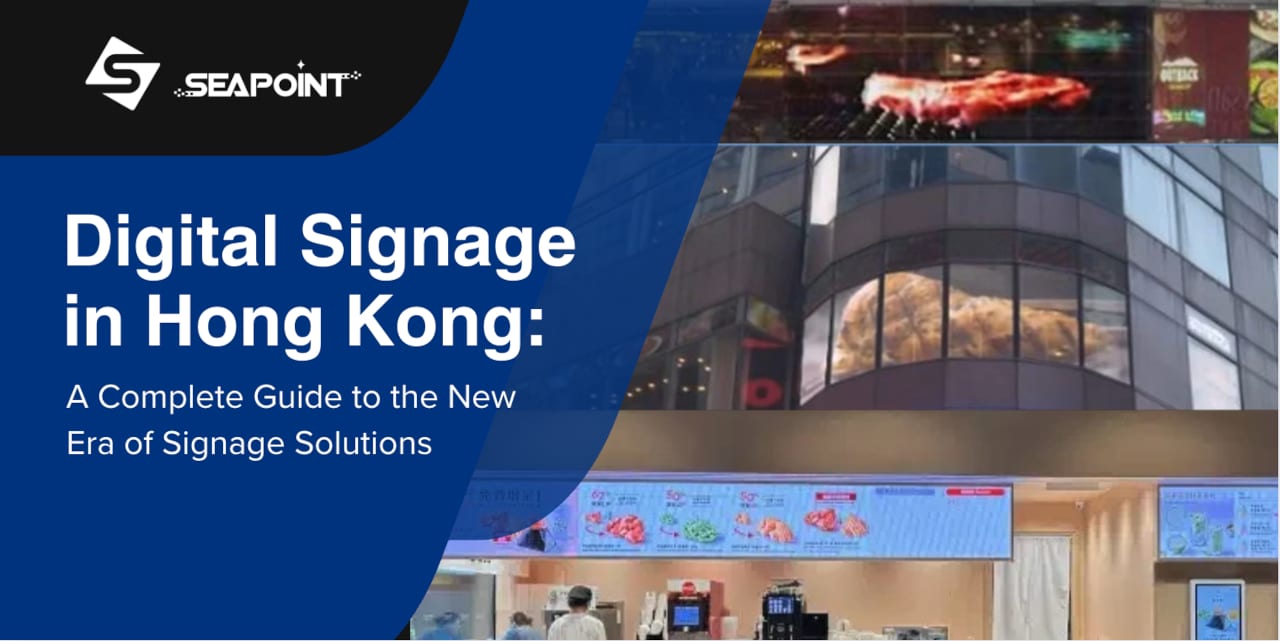
In 2026, digital signage has firmly established itself as one of the most practical investments available to Hong Kong's F&B and retail businesses. A well-deployed Digital Signage Solution does three things simultaneously: it sharpens your brand presence, streamlines daily operations, and communicates with customers more effectively than any static sign ever could. Whether you're exploring interactive signage for a restaurant, a digital menu for your café, or a high-impact LED advertising display for your shopfront, this guide gives you a clear, honest picture of how digital signage works in practice — drawing on Sea Point's direct experience delivering signage solutions to businesses across Hong Kong, from international retail chains to independent restaurant groups.
What Exactly Is Digital Signage — and Why Is It Now a Business Essential?
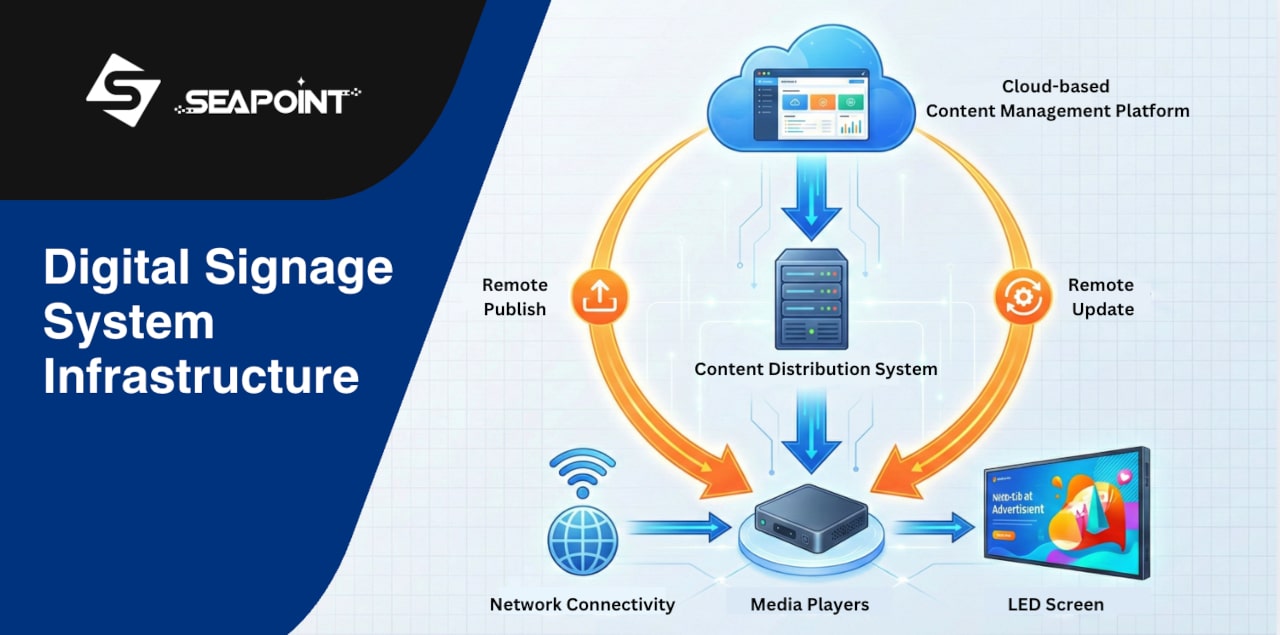
Digital signage is defined as any networked system of electronic displays used to show dynamic, remotely managed content. Unlike a printed poster or a static lightbox, a digital signage system can be updated instantly — from anywhere, at any time — and can display anything from looping video and animated graphics to real-time data feeds and scheduled promotions.
A complete Digital Signage Solution typically consists of three integrated layers: the hardware (LED screens, media players, and mounting infrastructure), the software (a cloud-based content management platform), and the network connectivity that ties it all together. The magic of the system is in how these three components work as one — content created on your laptop in the office appears on screens across all your branches within seconds.
In Hong Kong's commercial environment — where lease costs are among the highest in the world, and customer attention spans are shorter than ever — that speed and flexibility carries real weight. Businesses that can react to market conditions in real time, update their offers instantly, and deliver consistently polished in-store experiences have a measurable advantage over those still working with printed materials and manual display swaps.
"From our experience working with F&B and retail clients across Hong Kong, the businesses that get the most out of digital signage are the ones that treat it as a live communication tool — not just a fancy screen. The ability to change content in minutes is what separates it from everything that came before." — Sea Point China Limited
How Is Digital Signage Transforming the F&B Industry in Hong Kong?
For Hong Kong's F&B operators — from high-volume cha chaan tengs and Japanese chain restaurants to premium hotel dining rooms — digital signage has reshaped the way menus, promotions, and operational information are communicated. The shift has been particularly significant in two areas: digital menus and interactive signage kiosks.
A digital menu replaces the traditional printed or lightbox menu board with a dynamic, remotely updated display. The practical benefits are immediate. Sold-out items can be removed instantly. Seasonal offerings can be added the same morning they launch. Pricing updates no longer require a print run. For any multi-branch F&B business in Hong Kong, managing menu consistency across locations used to mean physically distributing new printed materials to each site — with digital menus, it's a single update from one platform.
Sea Point has worked with a number of well-known F&B brands to implement digital menu systems at scale. One particularly instructive project involved a Japanese restaurant chain store operating across multiple Hong Kong locations. The client needed a system that could handle complex menu structures, integrate smoothly with their existing POS Systems, and support remote content management across all sites simultaneously. Sea Point designed and deployed a fully integrated digital menu solution that met every requirement — see the full Japanese restaurant chain store case study for the details.
Interactive signage takes the customer engagement one step further. Rather than passively displaying content, interactive kiosks allow customers to browse menus, customise orders, and even complete transactions independently — reducing queue pressure, cutting order errors, and freeing up front-of-house staff to focus on service quality rather than order-taking. For busy Hong Kong restaurants where peak-hour queues are a constant challenge, that operational benefit alone can justify the investment.
What Can Digital Signage Do for Hong Kong Retailers?
In retail, digital signage plays a different but equally powerful role. Rather than driving operational efficiency at the point of order, retail digital signage is primarily about influencing purchase decisions — catching attention, reinforcing brand values, promoting specific products, and guiding customers through the space.
At the shopfront level, a high-brightness LED advertising display is one of the most effective tools available. In a busy Hong Kong street where ten competing businesses share the same block, a dynamic display showing product highlights, seasonal campaigns, or brand video content has a significantly higher chance of stopping foot traffic than a static sign. Sea Point's LED Display/Lighting Solutions are engineered specifically for Hong Kong's outdoor and semi-outdoor conditions — high ambient brightness, moisture resistance, and the durability to operate reliably in the city's demanding climate.
A strong example from our portfolio is our work with the Worldwide Furniture Chain Store — an internationally recognised brand synonymous with modern, accessible design. Sea Point installed high-quality LED displays in their Hong Kong restaurant and bistro areas to present menus, brand education content, and store navigation information. Using Sea Point's remote publishing functionality, the client's marketing team can update seasonal content from their own offices without any on-site intervention. The result was a smoother customer experience, cleaner operations, and a meaningful improvement in sales performance. Full details are available in the Worldwide Furniture Chain Store case study.
Inside the store, interactive signage opens up new possibilities for product discovery and wayfinding. Touch-enabled displays can give customers access to full product catalogues, stock availability, and technical specifications — information that would otherwise require staff assistance. For large-format retail environments in Hong Kong, this kind of self-service capability meaningfully reduces the load on the shop floor while improving the customer experience.
How Does a Japanese Origiri Chain Use LED Displays to Communicate Quality?
One of the most visually striking digital signage projects Sea Point has completed in Hong Kong involved installing ultra-high-definition LED screens for a Japanese Origiri Chain operating across 100 locations in the city. The client's goal was unambiguous: they wanted every customer to see exactly how good their product looked — the texture, the freshness, the craftsmanship — in stunning visual detail.
Sea Point installed large-format 4K wall displays and portrait-orientation screens positioned to capture foot traffic at the most effective angles. The content management system was custom-configured to handle 4K playback natively, support automated menu scheduling by time of day, and manage promotional integration across all 100 locations through a single cloud platform. The effect was immediate — the displays create a powerful first impression that communicates the brand's quality commitment before a customer has even walked through the door.
This project illustrates something we see consistently in food retail: when your product looks outstanding, showing it well is one of the most effective marketing decisions you can make. The full details are in the LED Display/Lighting Solutions case study for the Japanese Origiri Chain.
How Does Digital Signage Connect With Other Smart Business Systems?
The full potential of digital signage is realised when it operates as part of an integrated business technology ecosystem rather than as a standalone display system. Sea Point designs and deploys solutions where multiple systems work together — and the results consistently outperform what any single system can deliver on its own.
The most immediate integration is with POS Systems. When a menu item sells out, the POS can automatically flag it on the connected digital menu board — removing it from display or marking it as unavailable — so customers never encounter the frustration of ordering something that isn't on. For busy F&B operators managing high order volumes, this real-time sync between POS and display removes a surprisingly common operational headache.
Digital signage also integrates effectively with People Counting Systems. When the footfall sensor detects that in-store traffic is low, the display system can automatically switch to more aggressive promotional content to draw customers in. During peak hours, the content can shift to brand-building material — a lighter approach that's more appropriate when the store is already full. This kind of data-driven, automated content switching is far more precise than anything achievable through manual scheduling.
In F&B settings, digital menu boards pair naturally with Queuing Systems. When a customer places an order, the display can show real-time wait times and order collection numbers — making the queue experience feel managed and transparent, which has a measurable positive impact on customer satisfaction and perceived wait time. Sea Point has implemented this integrated setup for several Hong Kong F&B clients, and the operational gains are consistently significant.
At the building level, digital signage is a core component of Smart Building Solutions. Display screens positioned at building entrances and common areas can communicate directory information, emergency notices, and visitor wayfinding — all centrally managed, automatically updated, and integrated with access control and facility management systems. Sea Point's multinational team has delivered smart building projects across multiple markets, and we bring that depth of experience to every integration assignment in Hong Kong.
What Should Hong Kong Businesses Look for When Choosing a Digital Signage Provider?
The digital signage market in Hong Kong is active and varied — and the quality of providers is equally varied. Making the right choice at the outset matters considerably, because a poorly chosen system means hardware reliability issues, software limitations, or support that disappears after the contract is signed. Based on Sea Point's experience evaluating the market and delivering solutions for demanding clients, here's what genuinely matters:
Local support infrastructure. Digital signage is not a one-time purchase — it's an ongoing operational dependency. When a screen goes down, or a software update introduces an issue, or content needs urgent attention, you need a support team that can respond the same day. A provider without a real local presence in Hong Kong will always be slower to respond than one with a dedicated technical team on the ground. Sea Point maintains a full technical team and a showroom in Hong Kong — if something needs fixing, we're here.
Integrated hardware and software design. The most reliable digital signage systems are designed as a complete, unified solution — hardware and software developed to work together. Be cautious of providers who supply off-the-shelf hardware and pair it with third-party software: compatibility problems and ambiguous accountability when things go wrong are predictable outcomes. Sea Point develops our own integrated solutions, which means one point of responsibility from installation through to maintenance.
A verifiable track record in your sector. Ask to see case studies from clients in the same industry. It's the clearest indicator of real-world capability. Sea Point's portfolio spans the full range of IT Innovation Solutions — retail, F&B, hospitality, and smart buildings — with documented deployments for clients including a Japanese Chain Drugstore, the Worldwide Furniture Chain Store, a Japanese restaurant chain store, and a Japanese Origiri Chain. That breadth of sector experience means we've encountered most implementation challenges before, and we know how to resolve them.
Scalability for future growth. Your signage needs will change as your business grows. The system you deploy today should be able to expand without requiring a complete replacement — whether that means adding new screens, new locations, or new integration with other business systems. Sea Point builds Digital Signage Solutions with scalability as a design principle, so your initial investment continues to deliver value as your requirements evolve.
Frequently Asked Questions
1. What is digital signage and how does it work?
Digital signage refers to networked electronic display systems that show dynamic, remotely managed content — replacing static signs, printed menus, and traditional lightboxes. A complete Digital Signage Solution consists of hardware (LED screens and media players), software (a cloud-based content management platform), and network connectivity. Content can be updated across all connected displays simultaneously, from any internet-connected device, in real time.
2. Is digital signage suitable for small F&B or retail businesses in Hong Kong?
Yes, absolutely. Sea Point offers scalable Digital Signage Solutions that are designed to work for businesses at every scale — from a single digital menu board for an independent restaurant to a fully networked display system spanning dozens of retail locations. Our consultants will identify the most practical and cost-effective entry point for your business, with a clear path to expansion when you're ready.
3. What is interactive signage and is it right for my business?
Interactive signage refers to digital displays that respond directly to customer input — typically via touchscreen, motion detection, or QR code integration. For F&B operators, this often means self-ordering kiosks that reduce queue pressure and order errors. For retailers, it can mean product exploration displays or wayfinding systems. Whether it's the right fit depends on your customer flow and operational model — Sea Point's team can advise based on direct experience with both formats across Hong Kong.
4. How do LED advertising displays generate value for Hong Kong businesses?
LED advertising displays generate value in two ways: direct promotion of your own products and services, and — for high-traffic locations — the opportunity to sell advertising timeslots to complementary brands, creating an additional revenue stream. LED displays also deliver significant energy savings over conventional lightboxes, with typical reductions of 60 to 70% in electricity consumption, alongside a substantially longer operational lifespan.
5. How does Sea Point's Digital Signage Solution differ from other providers in Hong Kong?
Sea Point's key differentiators are integrated hardware-software design, in-house development capability, and a genuine local presence in Hong Kong — including a showroom where clients can experience different Digital Signage Solutions live before committing. Our team covers the full delivery cycle from system design and installation to content management and after-sales support. As a multinational with deep roots in the Hong Kong market, we combine international solution standards with the kind of local knowledge that actually makes a practical difference. Browse our LED Display/Lighting Solutions case studies to see what we've delivered.
Ready to Enter the New Era of Digital Signage? Let's Build the Right Solution Together
Digital signage has moved well past the point of being a luxury for large enterprises. In 2026, a well-chosen Digital Signage Solution is a practical, accessible investment for any Hong Kong F&B or retail business that wants to compete effectively — whether that means a digital menu that updates in seconds, an interactive signage kiosk that takes the pressure off your front-of-house team, or an LED advertising display that makes your shopfront impossible to walk past.
Sea Point's Hong Kong showroom is open for business visits. Come and see different digital signage configurations running live — digital menus, interactive signage, LED advertising displays, and fully integrated smart system setups — and have a direct, practical conversation with our technical consultants about what would genuinely work for your operation. There's no substitute for seeing the technology in person before you decide.
Contact us or book a showroom visit — consultations are free, and we're always happy to walk through your options honestly before you make any decisions. Let Sea Point help your business make the most of what modern signage solutions can do.